
AOSU camera
Independent site whose links lead to the official AOSU products.
BATTERY CAMERA
WIRED CAMERAS
INDOOR CAMERAS
SOLAR CAMERAS
VIDEO DOORBELLS
By Thomas Rivière, Product Analyst — Last updated: 30 September 2026
Ultimate Guide to AOSU Solar Cameras – Comparison & Advice 2026
Outdoor security for your home has never been easier than with AOSU SolarCam cameras: they offer complete autonomy, high image quality and intelligent features with no subscription. In this comparison, we analyse the best AOSU solar camera models, their features, strengths and use cases to help you make the right choice.
Why Choose an AOSU Solar Camera?
AOSU SolarCam cameras stand out for:
- Fully autonomous power thanks to an integrated solar panel — no more cables or power sockets needed.
- Detailed vision even at night, with colour night vision technology.
- Intelligent detection of humans/animals/vehicles thanks to onboard AI.
- Smart home compatibility: works with Alexa & Google Assistant.
- Flexible storage: microSD and sometimes cloud option (no subscription required).
AOSU Solar Cameras Comparison
| Model | Resolution | 360° Rotation | AI & Detection | Spotlight/Alarm | Ideal For |
|---|---|---|---|---|---|
| SolarCam P1 Max | 4K Ultra HD | ❌ (fixed) | Yes, people/vehicles/animals | Spotlight + alarm | Ultra-sharp detail & wide areas |
| SolarCam D1 Max | 5MP (≃ 3K) | ✔️ PTZ | Yes (people/animals/vehicles) | Spotlight + siren | Full 360° surveillance |
| SolarCam D1 SE | 5MP (≃ 3K) | ✔️ PTZ | Yes (people/vehicles) | Spotlight + siren | Best value for money |
| SolarCam D1 Lite | ~3MP (2K) | ✔️ PTZ | Yes (people) | Spotlight + audio | Solid PTZ budget pick |
| SolarCam D1 Classic | ~3MP (2K) | ✔️ PTZ | Yes (people) | Spotlight + audio | Budget PTZ |
| SolarCam P1 Lite | 2K | ❌ | Yes (PIR + AI) | Spotlight + siren | Small compact solar camera |
This table summarises the key specifications of the currently available AOSU SolarCam models.
Detailed Model Presentations
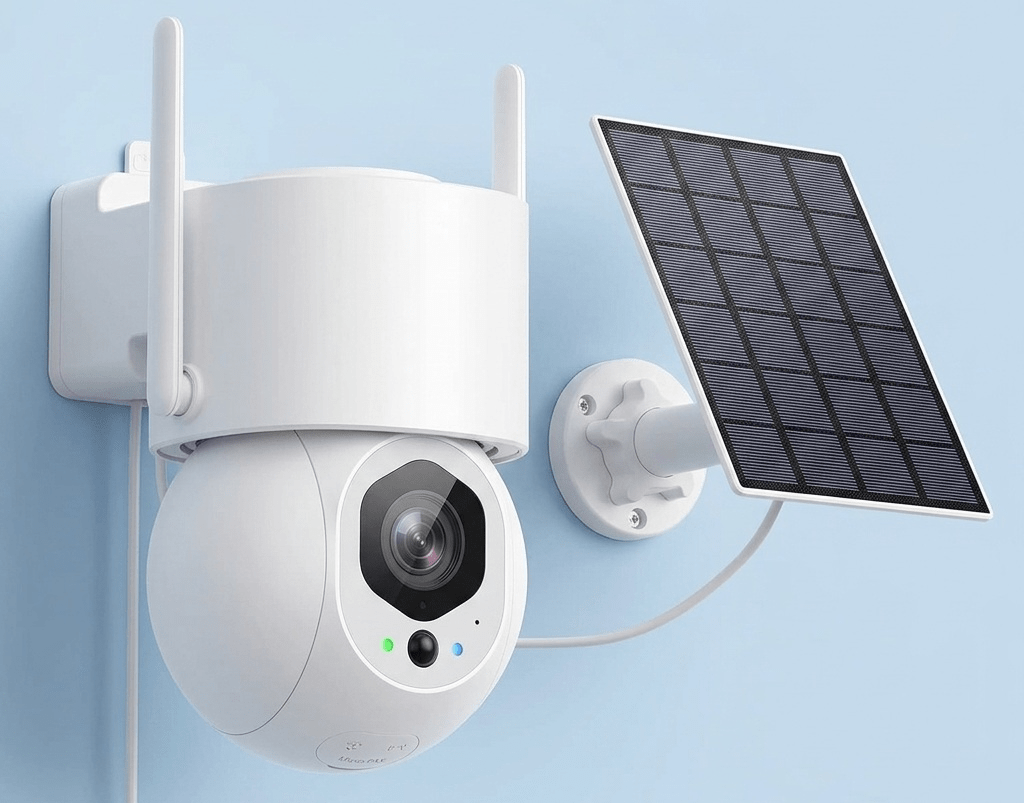
SolarCam P1 Max
The premium AOSU solar camera with 4K Ultra HD resolution. It delivers extremely detailed images, even at x6 zoom, and is perfect for monitoring large areas such as driveways, gardens or garage entrances. It combines advanced AI, people/vehicle/animal differentiation, an integrated spotlight and alarm — all with no subscription.
Key strengths:
- Ultra-detailed 4K video + powerful zoom.
- Smart lighting + alarm.
- Precise Smart Detection function.
Ideal if you want the best solar image quality available.
SolarCam D1 Max
One of the most versatile solar cameras in the AOSU range, with 5MP (≈3K) resolution and 360° PTZ rotation to eliminate blind spots. It automatically tracks detected motion while providing colour night vision and a 400-lumen spotlight.
Ideal if:
You want complete 360° coverage.
You want advanced detection including people, vehicles and animals.
SolarCam D1 SE
The competitive model in the PTZ range with 5MP offering a sharper image than the Lite/Classic versions, while retaining intelligent detection, spotlight & siren, and two-way audio to respond remotely when activity is detected.
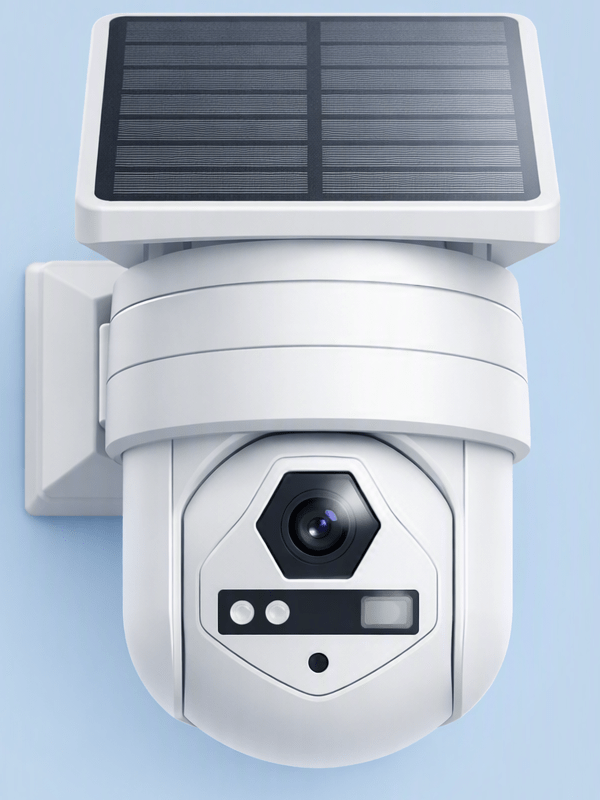
Excellent performance-to-price ratio for a camera with advanced features at no extra cost.
SolarCam D1 Lite & D1 Classic
These models build on the solid D1 range foundations with 360° panoramic PTZ, 2K resolution and automatic person tracking at a more affordable price point.
Ideal for medium-sized outdoor areas or as a first level of security.
SolarCam P1 Lite
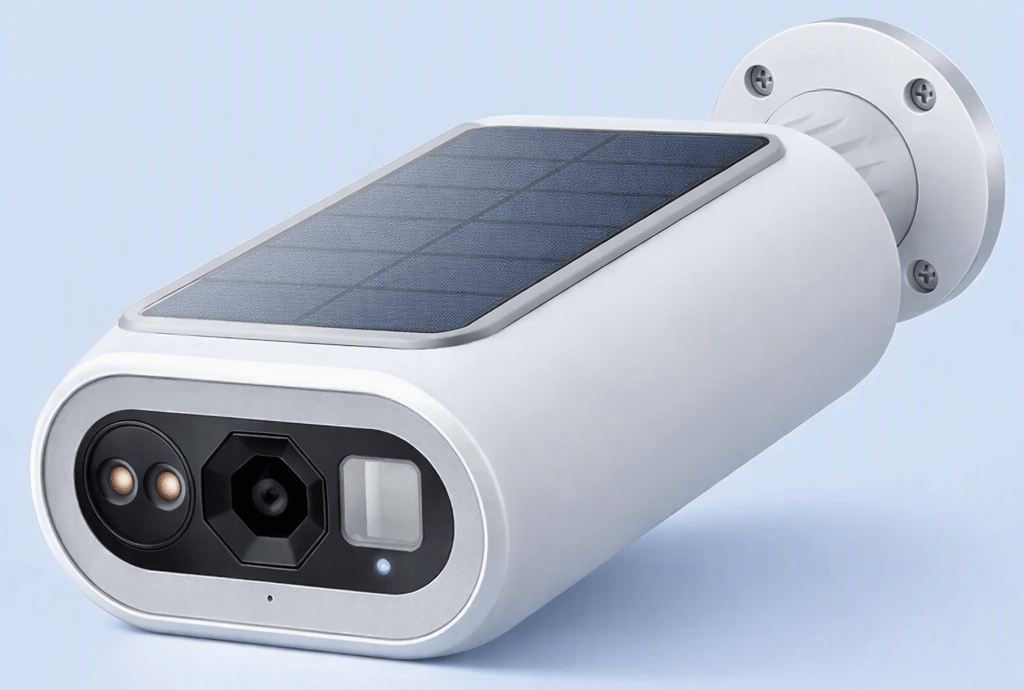
Compact solar camera with 2K resolution, enhanced PIR detection and LED lighting for instant alerts. Perfect for smaller areas or as a supplementary camera.
Tips for Choosing Your AOSU Solar Camera
Based on your main need:
- Priority: detail and recognition: SolarCam P1 Max for ultra-sharp images and easy face/plate identification.
- Total coverage with no blind spots: SolarCam D1 Max / D1 SE with 360° PTZ.
- Balanced budget: SolarCam D1 Lite or Classic.
- Compact solar camera: SolarCam P1 Lite.
Advantages of AOSU Solar Cameras
- Simple installation with no cabling.
- Complete autonomy with no regular maintenance (2–3 hours of sunlight per day is sufficient).
- Alexa & Google Assistant compatible for seamless smart home integration.
- No mandatory subscription fees (local storage via microSD).
Key Takeaways
- 6 SolarCam models: P1 Max (4K), D1 Max (5MP PTZ), D1 SE, D1 Lite, D1 Classic, P1 Lite.
- 360° PTZ available on D1 Max, D1 SE, D1 Lite and D1 Classic.
- P1 Max = best resolution (4K); D1 Max = best coverage (PTZ + 5MP).
- Full solar autonomy — 2 to 3 hours of sunlight per day is sufficient.
- No mandatory subscription across the entire range — microSD included.
The AOSU SolarCam range offers solar security solutions for every need: from the compact SolarCam P1 Lite to the ultra-high-performance SolarCam P1 Max 4K, you have options to effectively secure your home, garden or entrance without any hassle or monthly subscription.
FAQ – AOSU SolarCam Solar Cameras
What is the best AOSU solar camera in 2026?
It depends on your use. For the best resolution (4K), choose the SolarCam P1 Max. For complete 360° coverage with 5MP, go for the D1 Max. For the best value for money with PTZ, the D1 SE is ideal.
Do AOSU solar cameras work on cloudy days?
Yes. AOSU’s high-efficiency solar panels recharge the battery even on overcast days, though more slowly. The built-in battery ensures continuous monitoring at night and on days with little sunshine.
What is the difference between the SolarCam D1 and P1 series?
The D1 series is motorised with 360° PTZ rotation, ideal for monitoring large areas with no blind spots. The P1 series has a fixed lens but offers higher resolution (up to 4K UHD), perfect for targeted areas requiring maximum detail.
Is a subscription required to use an AOSU SolarCam?
No, all AOSU SolarCam cameras work without a mandatory subscription. Local recording on a microSD card is included. An optional cloud service is available for those who want off-site backup.
Are AOSU solar cameras weather-resistant?
Yes. All SolarCam models are IP65 certified or higher, enabling them to withstand rain, snow, dust and extreme temperature variations for reliable year-round monitoring.
Explore the AOSU SolarCam D1 Classic for reliable entry-level solar security, discover the AOSU SolarCam D1 SE 3K with advanced AI detection, or check out the AOSU SolarCam D1 Max 5MP for ultimate outdoor performance.
Solar security cameras: buyer’s guide for 2026
Choosing a solar security camera in 2026 means navigating a broader range of options than ever before. The key specifications to evaluate are solar panel wattage, battery capacity, sensor resolution, AI detection capability and local storage support. Panel wattage determines charging speed in partial sun: 3.5 to 4 W models (AOSU D1 SE, D1 Max, P1 Max) maintain charge with as little as 2.5 hours of indirect sunlight per day, making them reliable year-round in northern climates. Entry-level 2 to 2.5 W panels require 4 to 5 hours and may need supplemental USB charging in northern European winters.
Battery capacity determines how many days a camera can operate independently without any solar input. Models with 5,000 to 6,000 mAh batteries can bridge one to two weeks of winter low-sun conditions without recharging. Local storage support — microSD cards up to 256 GB — is a critical differentiator: it allows weeks of footage archive without any subscription fee. Across all these criteria, the AOSU SolarCam range represents a strong value proposition, with all models supporting local storage and subscription-free AI detection out of the box.
Installation best practices for solar cameras in the UK
Optimal solar camera performance in the UK depends primarily on panel orientation. A south-facing panel at 35 degrees from horizontal captures approximately 40% more energy per day than an east or west-facing installation at the same latitude. For properties with constrained wall orientations, models with a detachable solar cable (AOSU D1 SE, D1 Max, P1 Max) allow you to route the panel to a south-facing surface while the camera covers the required zone on an adjacent wall — a critical flexibility advantage in terrace houses or properties with limited south-facing wall space.
Cleaning the solar panel every two to three months maintains charging efficiency in typical UK conditions. Dust, pollen, bird droppings and industrial pollution can reduce panel output by 10 to 30% in urban and agricultural environments. A damp cloth or soft sponge is sufficient — never use abrasive materials on the tempered glass surface. The AOSU app provides solar charging history data in real time, allowing you to identify efficiency drops that indicate a dirty panel or a new seasonal shading issue from a growing tree or new structure near the installation point.
Long-term ownership: lifespan, battery and firmware
Setup is straightforward across the range: mount the camera, orient the solar panel south at 30 to 40 degrees, pair via QR code in the AOSU app, then configure detection zones and notification preferences. Most first-time users are operational within 20 minutes of unpacking, and AOSU provides a quick-start guide plus video tutorials through its support portal and YouTube channel.
With proper installation and basic maintenance, AOSU SolarCam cameras are designed to deliver five to eight years of reliable service. The rechargeable battery is rated for 500 or more charge cycles and is sealed within the weatherproof housing — not user-replaceable — while the IP65/IP67 housing resists UV degradation and water ingress over many years. Firmware updates are free for the lifetime of the device and delivered automatically via the app; past updates have added new AI detection classes such as parcel detection and licence plate recognition, so enabling automatic updates keeps older models benefiting from improvements long after purchase.
Frequently Asked Questions
Which AOSU solar camera is best for northern Europe?
For the UK, Ireland, Belgium, the Netherlands, Germany and Scandinavia, the AOSU SolarCam D1 SE, D1 Max or P1 Max are the recommended models. These feature 3.5 to 4 W solar panels that can maintain full charge with as little as two to three hours of indirect sunlight per day. Users in Scotland, Norway and northern Germany report year-round autonomous operation on these models. The D1 Classic, D1 Lite and P1 Lite with smaller 2.5 to 3 W panels are better suited for southern Europe where sun hours are more generous throughout the year.
How often should I expect to clean the solar panel?
In a typical UK urban or suburban environment, cleaning the solar panel once every two to three months is sufficient to maintain peak charging efficiency. In agricultural areas with dust and pollen, monthly cleaning may be beneficial. The AOSU app displays solar charging history and current battery level, which provides a practical indicator — if the battery level is gradually declining over several weeks despite reasonable weather, a dirty panel is the most likely cause and cleaning should restore normal charging performance immediately.
Can AOSU solar cameras be used indoors?
AOSU solar cameras are designed specifically for outdoor use. Their IP65 to IP67 weatherproofing, wide operating temperature range and solar panel integration make them unsuitable for typical indoor environments where power sockets are available and smaller, more discreet camera options exist. For indoor monitoring, AOSU recommends the IndoorCam P1 or P1 Pro, which are purpose-designed for interior use with features such as privacy mode, auto-tracking and audio that are better suited to residential indoor surveillance requirements.
Do SolarCam cameras work without Wi-Fi?
A Wi-Fi connection is required to receive real-time alerts and view the live video feed. Local recording to a microSD card may continue depending on the model, even during a temporary internet outage.
How many years does an AOSU solar camera typically last?
Five to eight years of reliable service is typical, driven mainly by the rechargeable battery (rated for 500 or more charge cycles) and the weatherproof housing’s resistance to UV and water ingress. Gradual battery capacity reduction over many years of cycling, rather than a sudden hardware failure, is the most common end-of-life indicator.
Summary
The AOSU SolarCam range covers every solar surveillance need: from the compact P1 Lite to the ultra-powerful P1 Max 4K, including the 360° PTZ D1 Max and D1 SE models. With no cabling and no mandatory subscription, every model installs in minutes and suits everything from a small garden to a large property.
Across the SolarCam range, panel wattage — not resolution — is what determines whether a camera holds its charge through a UK or Scandinavian winter: the D1 SE’s 3.5 W and the D1 Max/P1 Max’s 4 W panels stay reliable on two to three hours of indirect sun where the entry-level D1 Classic and D1 Lite need more consistent daily exposure.